

The way people search is changing faster than most businesses realize. Here’s what you need to know about AI search optimization—and why getting started now matters, even in an evolving landscape.
Recently, I asked ChatGPT a simple question: “What are the best marketing agencies in Holland, Michigan?”
The AI didn’t show me ten blue links. It didn’t give me a list of paid advertisers. Instead, it generated a conversational answer, naming specific agencies, describing their specialties, and making recommendations based on my needs.
Boileau & Co. made the cut, but only after listing several agencies that aren’t even based here.
And here’s the uncomfortable truth: If your business serves customers who research solutions online, you’re probably not listed either. Not yet, anyway.
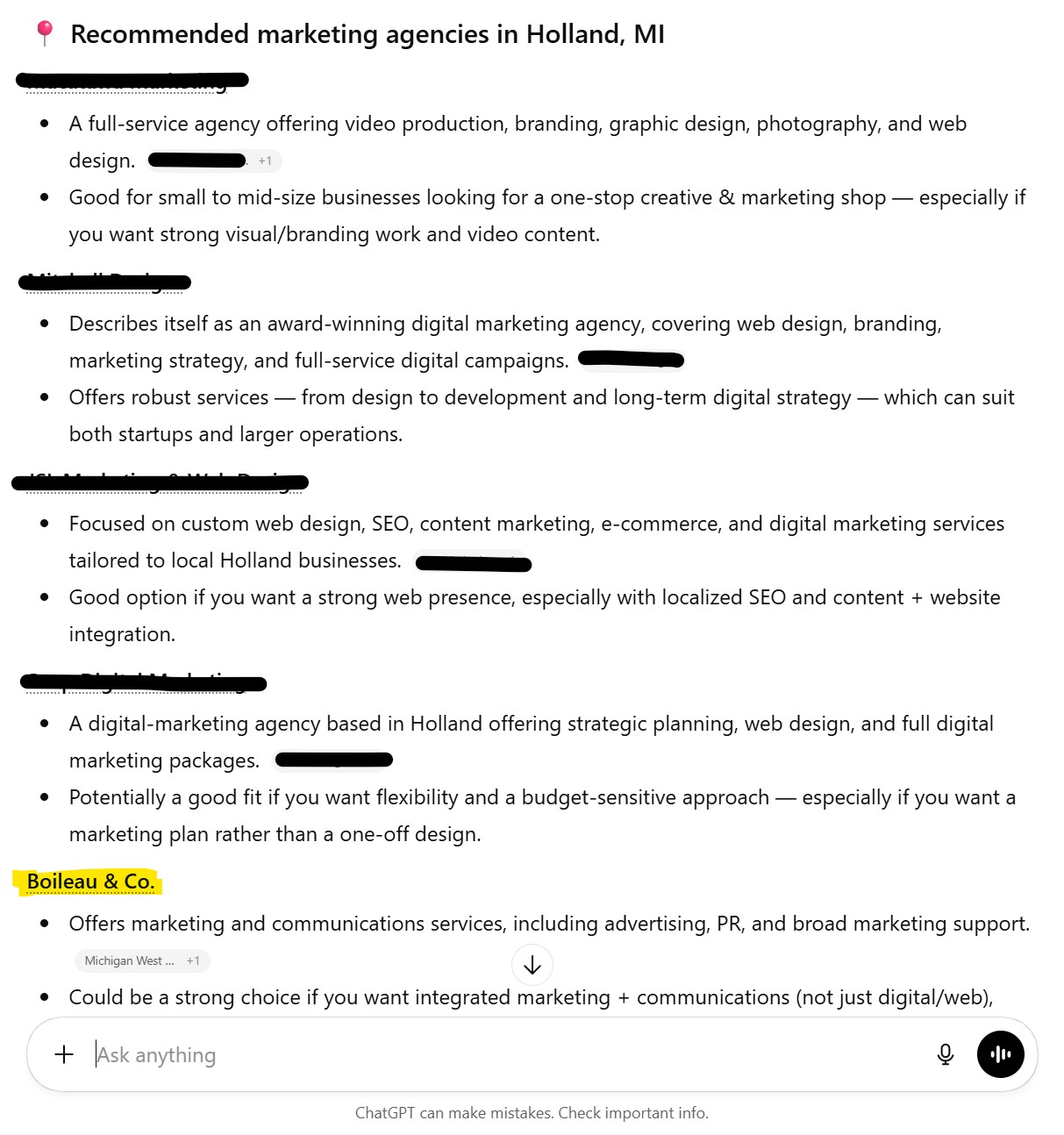
My ChatGPT Search. Competitors redacted for your protection.
The Shift to AI Search is Already Happening
Search behavior is fragmenting across new platforms faster than most of us anticipated. According to the Pew Research Center’s 2026 survey, 49% of U.S. adults now use AI chatbots, and it’s not just ChatGPT (44%). About a quarter use Gemini, and 17% use Copilot.
More importantly, the same survey found that about four in ten U.S. adults use chatbots to search for information, making search their most common use. Six in ten also say they read the AI summaries at the top of search results, so even people who never open a chatbot are seeing AI answers. Among employed adults, 38% use chatbots for tasks at work. This matters for those of us in B2B marketing and professional services. The people using AI search aren’t casual browsers. They’re researchers, decision-makers, and problem-solvers. They’re exactly the audience many of us are trying to reach.
What Is AI Optimization (AIO)?
Artificial Intelligence Optimization (AIO), sometimes called Generative Engine Optimization (GEO), is the practice of ensuring your brand shows up accurately and strategically when AI platforms like ChatGPT, Google’s AI Overviews, Perplexity, or Claude generate answers to user questions.
Unlike traditional SEO, where you optimize for rankings in search results, AIO focuses on being cited, mentioned, or recommended within AI-generated responses. When someone asks an AI assistant about services in your industry, you want your organization to be part of that conversation.
Companies approach AIO through several interconnected strategies:
- Structure content with clear hierarchies and direct answers to common questions, making it easier for AI systems to parse and understand.
- Implement structured data that helps AI platforms categorize and connect information accurately.
- Build authority signals through citations, credentials, and references that AI models recognize as trustworthy.
- Earn visibility beyond your own website through reviews, press coverage, and industry publications, since AI platforms draw on third-party sources when deciding who to recommend.
- Ensure technical foundations are sound like fast loading times and clean code, and make sure AI crawlers, the automated programs these platforms use to scan the web (including in real time, when someone asks a question that needs current information), can reliably reach your site.
- Create detailed, expertise-driven content that demonstrates clear subject-matter knowledge, the kind of comprehensive resources AI platforms prefer to cite when generating answers.
Why AIO Is Hard to Measure
Unlike traditional SEO, where we can track keyword rankings with precision and watch traffic analytics in real-time, AIO measurement is…messier. With SEO, we are working with a more-or-less predictable algorithm from Google (or Bing). We know generally what levers to pull and what winning looks like: being on top of the search pile. However, AI responses are largely private and personalized, which creates legitimate measurement challenges.
Ranking well on Google still matters, but it doesn’t guarantee you a spot in the answer. Google’s own documentation explains that its AI features run several related searches behind the scenes to build a single response, so the pages they pull from can differ from what you’d see searching the question yourself.
What you can track:
✅ Mentions across AI platforms (ChatGPT, Gemini, Perplexity, Claude) by setting up a broad swath of ‘representative’ pre-set prompts.
✅ Citation frequency and which sources AI platforms reference
✅ Sentiment analysis (how AI describes your company, whether positively, neutrally, or negatively)
✅ Share of voice compared to specific competitors that you identify
✅ Referral traffic from AI platforms (via standard Google Analytics)
✅ Impressions in Google’s AI Overviews and AI Mode (via Google Search Console)
What’s limited:
❌ We don’t have “search volume” data for AI queries (no one knows exactly how many people are asking specific questions)
❌ You can only monitor specific prompts that you define as relevant
❌ Attribution and citations get fuzzy when AI synthesizes information from multiple sources. You’ll see this often in Google AI Overviews where the cited links don’t have the same data as the overview.
❌ Results vary really widely based on user location, search history, their conversation history and AI model versions
Tools for Measuring AIO/GEO
The measurement challenge hasn’t stopped established players from building solutions. Semrush introduced Enterprise AIO in 2025 specifically to track brand visibility across AI platforms like ChatGPT, Perplexity, and Gemini. Their system monitors brand mentions, analyzes sentiment, and provides competitive benchmarking—essentially bringing familiar SEO-style measurement to the AI search ecosystem.
Similarly, newer platforms like Writesonic’s GEO tool and Profound have emerged specifically for AI search visibility tracking. These tools work by programmatically testing dozens (or thousands) of prompts across AI platforms, parsing responses to identify brand mentions, and tracking changes over time.
The sophistication of these tools suggests something important: even with imperfect measurement, there’s enough data to make decisions. We’re not flying blind, but we need to accept that this is more like weather forecasting than GPS navigation.
First Steps: What You Can Do Now
If you’re reading this and thinking “I should probably do something about this,” you’re right. But you don’t need to overhaul your entire marketing strategy overnight. Here are practical first steps that can provide valuable insights without massive investment:
1. Test Your Own Visibility
Right now, open ChatGPT, Claude, or Perplexity and ask questions your customers might ask:
- “What are the best [your service type] companies in [your region]?”
- “Who can help with [specific problem you solve]?”
- “What should I look for when choosing [your type of provider]?”
Take notes and keep a record of these chats. See if you appear. Note which competitors show up and how they’re described. This 15-minute exercise will tell you more about your AI search presence than any amount of theorizing.
2. Set Up Basic Monitoring
Consider subscribing to a monitoring service—even at the entry level. Tools like Writesonic can be a little pricey but if you’ve already got an SEO account set up with Semrush or Moz, consider expanding that subscription to their newer AI tools.
Most of them work the same way. You set up a field of specific prompts relevant to your business (or use the tool to suggest those), and the tool will ‘ping’ those prompts across the major AI platforms at a certain interval, usually a couple times a day to see where your results land.
3. Optimize Your Existing Content
The good news: many AIO/GEO best practices overlap with good content and SEO strategy. AI platforms favor content that is:
- Clear and well-structured (proper heading hierarchy, logical flow)
- Authoritative (cites sources, demonstrates expertise, shows credentials)
- Specific and detailed (answers questions thoroughly rather than vaguely)
- Technically sound (proper schema markup, clean HTML, fast loading)
An audit of your website’s content structure, schema implementation, and information architecture—work many agencies already do for SEO—provides value for both traditional search and AI visibility.
Before you invest in new content, make sure AI systems can actually reach your site. It’s one of the first things an audit checks. AI platforms send automated crawlers to scan the web ahead of time, and they also look up pages in real time when someone asks a question that needs current information. If either one is blocked, your best content may never make it into an answer.
4. Document Your Expertise
AI platforms increasingly reference detailed, helpful content that demonstrates clear subject-matter expertise. This means:
- Publishing thoughtful case studies (not just surface-level testimonials)
- Creating comprehensive guides that answer customer questions thoroughly
- Sharing methodologies and frameworks unique to your approach (don’t give away any IP though!!!)
- Being findable on platforms AI systems already trust (LinkedIn, news sites, review sites, directories, industry publications, etc)
It’s also not only about your own website. AI answers can reflect what other sites say about you, in reviews, press coverage, and industry publications, and genuine mentions matter more than manufactured ones.
None of this is revolutionary—it’s just good marketing. But it matters more now that AI systems are actively evaluating which sources to trust and cite.
A Marketing Company in Holland, MI Who Can Help
Boileau & Co. is approaching AIO/GEO the same way we approach any emerging channel: with measured curiosity, healthy skepticism, and a commitment to transparency in the partnership.
There’s no silver bullet on AI. No surprise there. However, if we work together, you can count on us to help you:
- Monitor how AI platforms currently see your company
- Identify gaps where competitors appear and you don’t
- Implement content and technical optimizations that improve AI understanding
- Track changes over time to understand what drives results
- Stay current as platforms evolve
We offer AIO services, and as the platforms and tactics keep changing, we keep investing, learning and adapting right along with them. If you’re a West Michigan business wondering whether AI search optimization matters for your industry, we’d be happy to run a visibility audit and talk through what makes sense for your situation.
The Right Moment for AIO
Five years from now, we’ll probably look back on 2026 as the year AI search became too big to ignore. The technology companies building these platforms have massive resources, millions of users, and strong incentives to improve their search experiences.
Meanwhile, most businesses, even sophisticated ones, haven’t really started moving to meet this shift.
That gap creates opportunity for those who start now, even imperfectly. Not because you’ll achieve dominance overnight, but because you’ll be learning and adapting while others are still deciding whether this matters.
The question isn’t whether AI search will matter to your business. It’s whether you’ll be ready when it does.
Want to understand your AI search visibility? Schedule a consultation to discuss how AIO might fit into your marketing strategy.
AIO FAQs
AIO, also sometimes called GEO (Generative Engine Optimization), is the practice of making sure your brand shows up accurately when AI platforms like ChatGPT, Google’s AI Overviews, Perplexity, or Claude generate answers. SEO focuses on where your pages rank in search results, while AIO focuses on being cited, mentioned, or recommended in the answer itself. The two overlap quite a bit, but ranking well on Google doesn’t guarantee a spot in an AI answer.
Your customers are already using these tools. Pew Research Center’s 2026 survey found that 49% of U.S. adults use AI chatbots, and about four in ten use them to search for information. If you’re not part of those answers, you’re missing prospects who never reach your website.
Start by asking ChatGPT, Claude, Gemini, or Perplexity the questions your customers would ask, like “What are the best [your service type] companies in [your region]?” Save the chats and note whether you appear and which competitors do. For ongoing AIO tracking, monitoring tools can follow brand mentions, citations, sentiment, and share of voice, and Google Search Console reports impressions in AI Overviews and AI Mode. What you can’t get is true search volume for AI queries, and results vary by user and platform. Think weather forecasting, not GPS.
Three things matter most in AIO. Access: AI crawlers need to be able to reach your site, both when they scan the web ahead of time and when they look up pages in real time. If either is blocked, your best content may never make it into an answer. Content: clear structure, specific and detailed answers, cited sources, visible credentials, schema markup where it fits, and fast, clean pages. Third-party presence: AI answers can reflect what other sites say about you, including reviews, press coverage, directories, and industry publications. Genuine mentions matter more than manufactured ones.
Yes. We’re a Holland, Michigan-based marketing agency that offers AIO/GEO services to businesses. We can run a visibility audit, monitor how AI platforms currently describe your company, identify where competitors appear and you don’t, implement content and technical optimizations, and track results as platforms evolve. Schedule a consultation with us to talk through what makes sense for you.






 54 W. 8th Street, Suite 210